Buying the wrong Ermeto fitting can leave you with a matching-looking thread, an incompatible tube, or a connection that fails under pressure. By checking the 24° cone standard, tube outside diameter, series, thread system, application limits, and installation requirements, you can place a precise order and screen nearby stock with confidence.
Key takeaways
- Match the fitting to the tube’s outside diameter and Ermeto series.
- Confirm the 24° cone before comparing BSP, NPT, JIC, or push-in fittings.
- Check pressure, temperature, tube material, and corrosion exposure together.
- Give the supplier the angle, thread, port, and replacement fitting details.
What an Ermeto fitting actually connects
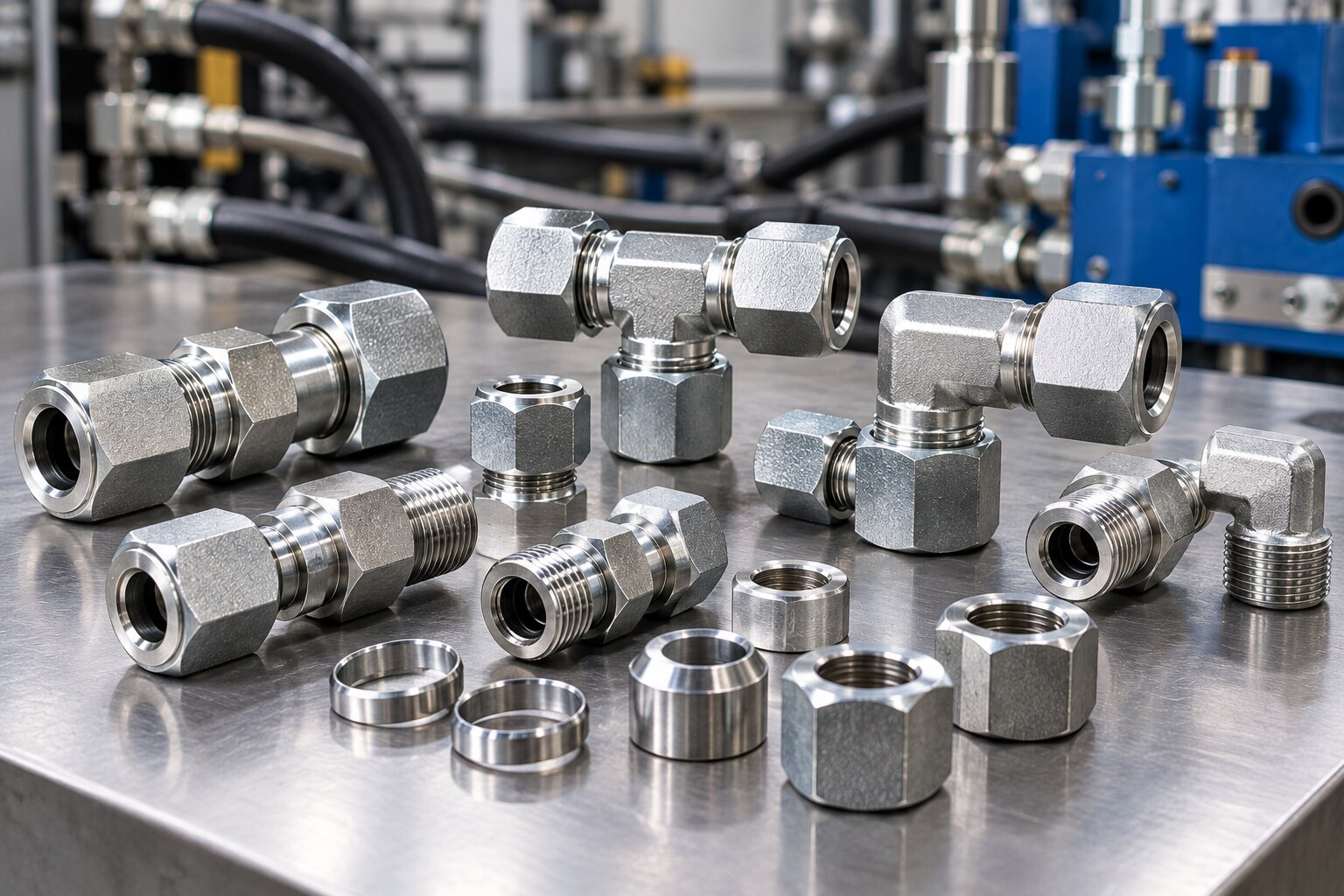
A carbon-steel Ermeto fitting connects a metallic tube to another tube, an adapter, a valve, or a machine port through a 24° cone.
Slide the nut and cutting ring onto the tube, insert the tube into the fitting body, then tighten the nut to drive the ring into the tube wall while the tube end seats against the cone.
That mechanical bite and cone contact create the seal; PTFE tape or liquid sealant does not belong on these sealing surfaces.
All parts must come from the same fitting system: the body, nut, cutting ring, tube outside diameter, and light (L) or heavy (S) series. The port thread must also match the mating port. A fitting with the same nominal thread can still fail if its cone angle, tube size, or series differs.
| System | Sealing geometry | Parts that must match |
|---|---|---|
| Ermeto/DIN 2353 or ISO 8434-1 | Metric 24° cone | Body, ring, nut, tube OD, and L or S series |
| JIC | 37° flare | JIC body, flare tube end, and nut |
| BSP or NPT port connection | Pipe thread | Matching port thread and approved sealant where specified |
A search for hydraulic ermeto fittings in mumbai is incomplete without stating whether the connection is tube-to-tube, tube-to-port, or hose-to-port. Do not substitute a JIC, BSP, NPT, or push-in part because its thread appears similar. Confirm the manufacturer’s system before assembly.
Specify tube size, series, thread, angle, and port configuration
Give the supplier a complete connection description, not “10 mm fitting”: state the tube outside diameter, L or S series, fitting form, thread standard and size, angle, and every port.
- Tube side: specify the actual outside diameter in millimetres, such as 10 mm or 15 mm, plus the tube wall thickness and material if known.
- Series: state light series (L) or heavy series (S). The same tube diameter can require different cutting rings, nuts, and bodies.
- Fitting form: identify straight, 45-degree elbow, 90-degree elbow, tee, branch tee, bulkhead, reducer, or hose adaptor.
- Port thread: list the standard and size separately, such as G 1/4 BSPP, R 1/4 BSPT, or 1/4-18 NPT. Do not write only “quarter-inch.”
- Port configuration: describe each end in order, for example “10 mm metric 24° tube cone to G 1/4 female port,” or “15 mm tube, 90-degree elbow, male stud.”
Include the manufacturer part number if replacing an existing fitting, along with carbon-steel grade or finish, working-pressure requirement, and required quantity. Ask for the pressure table and batch or inspection documentation when the application is safety-critical.
Searching for ermeto carbon steel fittings in masjid bunder mumbai identifies a location, not a specification; the written order must identify every connection independently.
Separate metric 24° cone fittings from BSP, NPT, JIC, and push-in types
Do not approve a replacement from “BSP” or “10 mm” alone. Record the tube outside diameter, port thread, connection standard, and sealing method before ordering.
| Standard | Identify it by | Do not substitute it for |
|---|---|---|
| Metric 24° cone | ISO 8434-1 or DIN 2353; tube, cutting ring, nut, and body form one system | JIC, which uses a 37° flare |
| BSPP | Parallel British pipe thread; sealing uses a bonded seal, O-ring, or face seal | BSPT or NPT without confirming the port design |
| BSPT | Tapered British pipe thread | BSPP or NPT |
| NPT | American tapered pipe thread under ASME B1.20.1 | BSP in an Ermeto assembly |
| Push-in | Tube enters a collet and seals with an internal elastomer | A 24° cone fitting |
A fitting can have a metric tube end and a BSPP or NPT port end. Write both independently: “10 mm tube OD × G1/4 female,” not “10 mm fitting.” Check the thread with the correct gauge or compare the old part’s thread, port form, and manufacturer marking.
Do not apply PTFE tape or liquid sealant to the 24° cone, cutting ring, or tube end. Sealant belongs only on an applicable pipe thread and must follow the manufacturer’s instructions.
A search for pneumatic fittings masjid bunder can return push-in parts, FRL components, and quick couplers, so state “metric 24° cone” or “pneumatic push-in” explicitly.
Check pressure, tube material, temperature, and corrosion limits
A carbon-steel Ermeto fitting is suitable when its rated working pressure exceeds the circuit’s maximum pressure, including startup spikes and vibration. Confirm this in the manufacturer’s pressure table for the complete assembly, not from the port thread or a “high-pressure” label.
The rating depends on the light (L) or heavy (S) series, tube outside diameter, wall thickness, fitting material, and temperature.
The tube also decides whether the fitting is appropriate. A fitting selected for seamless steel tube is not automatically suitable for thermoplastic tube, hydraulic hose, or a hose-to-port transition. Do not force a tube fitting into another connection type.
Before ordering hydraulic Ermeto fittings in Mumbai, record these application limits:
- Circuit pressure: normal working pressure, pressure spikes, and whether the line carries hydraulic oil, water, air, or another fluid.
- Tube specification: material, outside diameter, wall thickness, and whether the assembly uses rigid tube, hose, or a port adapter.
- Fitting configuration: metric 24° cone, L or S series, port thread and size, angle, and end connection.
- Temperature: minimum and maximum fluid and ambient temperatures; compare both with the fitting, seal, tube, and finish ratings.
- Corrosion exposure: washdown water, marine air, chemicals, or persistent condensation. Compare the specified plating or coating and salt-spray requirement with the service; carbon steel is not stainless steel.
- Sealing method: keep PTFE tape and liquid sealant off the 24° cone and cutting-ring surfaces. Use sealant only on a pipe thread when the manufacturer permits it.
Use a local stock and replacement checklist before ordering
A catalogue listing does not prove that an urgent replacement is physically available near Masjid Bunder. Before travelling, ask an ermeto fitting dealer near me to read back the complete identification, not just confirm “carbon steel fitting.”
1. Confirm that the part is a metric 24° cone fitting, then state the tube outside diameter and series: light (L) or heavy (S).
2. Give the exact fitting form and port thread, such as straight union, tee, elbow, bulkhead, BSP, or NPT. The same nominal thread does not make two bodies interchangeable.
3. Request the manufacturer part number, quantity on hand, working-pressure rating, carbon-steel finish, and seal material where the assembly includes a seal.
4. Ask the seller to confirm physical stock, not catalogue availability, and check whether each item is in original packaging with a batch number or inspection document.
5. State whether the replacement connects steel tube, thermoplastic hose, or a hose-to-port transition. Do not accept a push-in pneumatic fitting because a search for “Pneumatic fittings Masjid Bunder” returned it.
6. Reject visually similar nuts, cutting rings, or fitting bodies unless the seller confirms system compatibility. Ask whether the item is an original packaged part or an unbranded equivalent.
M/S Gautam Bearing & Tools can be included in your comparison of a carbon steel ermeto fitting supplier in mumbai, but location alone proves nothing. For washdown, marine air, chemicals, or persistent condensation, also request the coating specification and corrosion limits before accepting carbon steel.
Related product
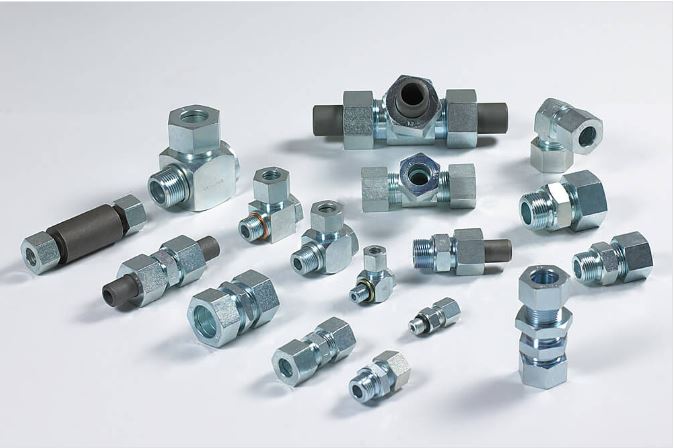 | Hydraulic, Pnuematic Fittings & Automation Valves, Pumps, Tubes Carbon Steel Fitting (Ermeto Fitting) Carbon Steel Ermeto Fittings are high-performance tube fittings designed for secure, leak-proof connections in hydraulic and pneumatic systems. View product → |
Frequently asked questions
What does an Ermeto carbon steel fitting connect?
It connects a metallic tube to another tube, adapter, valve, or machine port through a 24° cone.
What details should you provide when ordering an Ermeto fitting?
Provide the tube outside diameter, fitting series, thread type and size, connection angle, and port configuration.
How does an Ermeto fitting differ from BSP, NPT, JIC, and push-in fittings?
An Ermeto fitting uses a metric tube connection with a 24° cone; BSP and NPT identify thread systems, JIC uses a 37° flare, and push-in fittings grip tubing through a collet.
What limits should you check before using a carbon steel Ermeto fitting?
Check the working pressure, tube material, operating temperature, fluid compatibility, and corrosion exposure for the complete connection.
What should you verify with a local supplier before ordering?
Confirm stock, exact part configuration, tube and thread measurements, quantity, replacement compatibility, and delivery details.
Keywords