A flat belt belongs on a Mumbai pump or compressor only when the machine has the right pulley geometry, shaft spacing, speed ratio, and load profile. You will be able to identify a suitable drive, measure a replacement, calculate its duty, set it safely, and specify materials for humidity, oil, heat, water, and dust.
Key takeaways
- Check for line shafts, flywheels, wide pulleys, and open-drive layouts.
- Measure belt width, thickness, length, pulley diameters, and shaft spacing.
- Calculate belt speed from pulley diameter and RPM before selecting a replacement.
- Correct alignment, tension, and pulley damage before increasing belt tension.
Which Mumbai pump and compressor machines actually use flat belts?
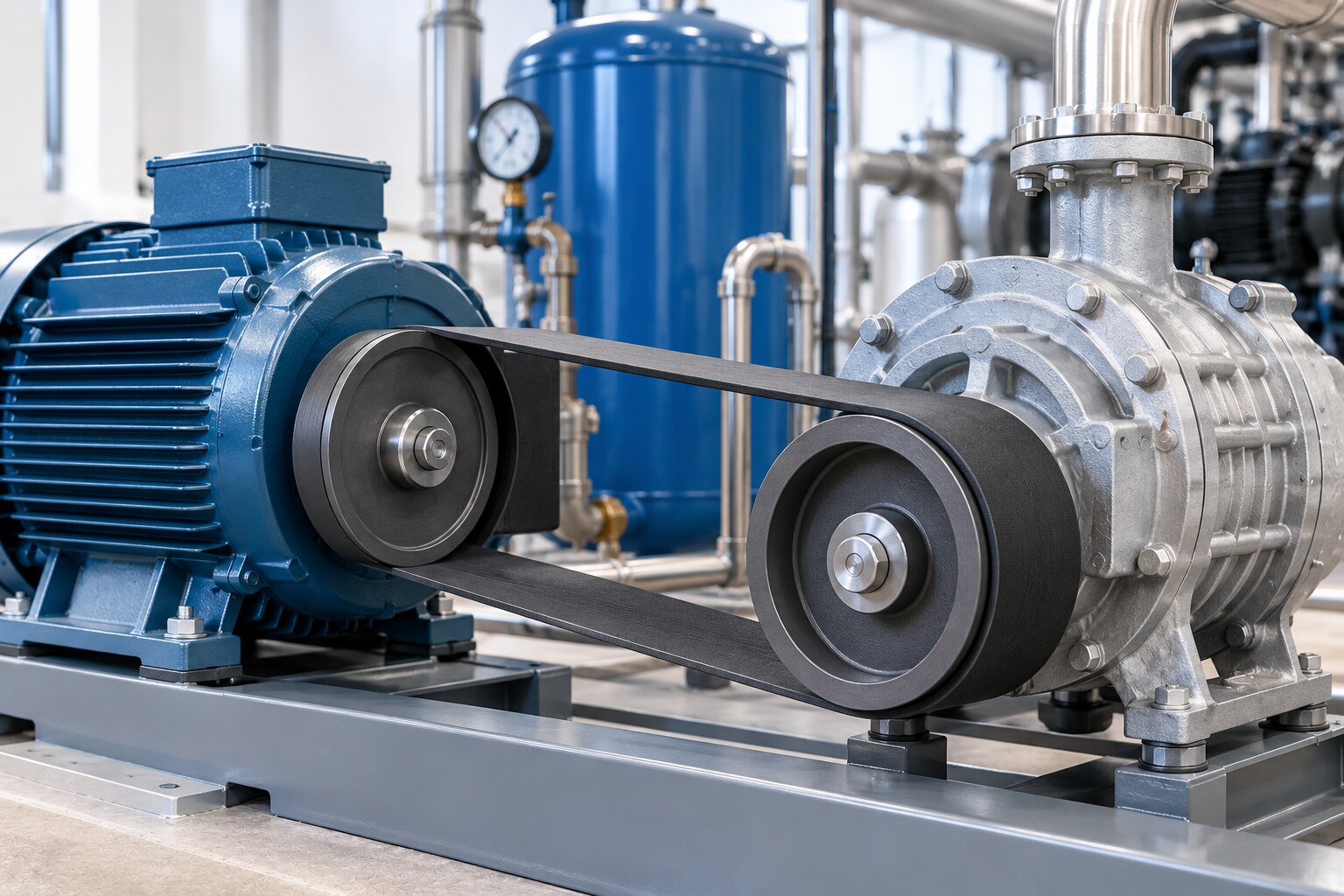
Legacy line-shaft pumps, open-drive centrifugal pumps, reciprocating compressors with flywheels, blower packages, fans, conveyors, textile machinery, agricultural equipment, and older workshop machine tools are the main flat belt applications. A new centrifugal pump is more commonly direct-coupled or fitted with V-belts because those arrangements need less shaft spacing and deliver more predictable speed.
| Machine type | Appropriate use | Retrofit warning |
|---|---|---|
| Line-shaft pump | Original open-drive layout with shared shafting | Replacing the shaft system changes alignment and load |
| Open-drive centrifugal pump | Existing crowned pulleys and documented ratio | Do not convert a direct-coupled set without engineering review |
| Reciprocating compressor | Flywheel drive designed for cyclic torque | Running horsepower alone misses starting and pulsating loads |
| Fan, blower, conveyor, textile or farm machine | Original flat-belt transmission | Exact no-slip speed may be essential for the process |
| Older machine tool | Factory-designed belt drive with adjustable centres | Guarding, tracking, and pulley condition can limit reuse |
A flat belt for pump equipment is justified only when the pulleys are crowned, centre distance is adequate, the speed ratio is documented, pulley wrap is sufficient, and the absorbed shaft load is known. Size it from absorbed power, not motor nameplate power.
Friction drive permits slip during overload, contamination, acceleration, or low tension. That causes speed loss, heat, glazing, and poor pump or compressor performance, so it is unsuitable where exact no-slip speed is essential. For flat belt for pumps and compressors in Mumbai, confirm the original machine design before approving any retrofit.
How do you identify and measure an existing flat-belt drive?
Verify the pulley geometry and belt path before ordering; you can specify a replacement flat transmission belt without removing the existing belt.
1. Confirm the drive: identify wide, thin belt faces, crowned pulley faces, and a continuous belt path rather than V-grooves, sprocket teeth, or a chain.
Record pulley face width, crown profile, surface finish, pulley diameters, shaft arrangement, centre distance, driver and driven shaft speeds, rotation direction, guard clearance, and every bend or twist in the path.
2. Identify the joint. An endless belt has no visible interruption; a welded belt has a prepared seam, while lacing or mechanical fasteners show clips, pins, staples, or plates. Record the joint type because a fastener can create thickness, noise, pulley-wear, and guard-clearance problems.
3. Measure belt length along the running line while the belt remains mounted, not along an outside edge. Measure width and thickness with calipers, pulley outside diameters across the working faces, centre distance between shaft centres, and both shaft speeds with a tachometer or machine record.
4. Do not copy an old purchase-order length blindly. Stretch, pulley wear, and a previous nonstandard splice can change the effective running length.
5. Check the replacement against the pulley geometry before installation. A flat belt on parallel-faced pulleys can wander, damage its edges, and eject; the crowned pulley must suit the belt width, and the crown must face the correct direction in the belt path. Record failure marks such as edge fraying, glazing, tracking, or splice separation.
How do you calculate belt speed, power, and starting duty?
Start with absorbed shaft power, not the motor nameplate. A flat belt for pump equipment is sized for the load reaching the pump shaft, then corrected by a service factor for starting, duty cycle, and shock.
Calculate belt speed as V = π × D × N, where D is the driver pulley diameter and N is driver rpm; keep units consistent. The running speed ratio is Ndriven/Ndriver = Ddriver/Ddriven × (1 − slip). Transmitted power is P = belt pull × V, with unit conversion applied.
| Check | Why it matters | Failure if ignored |
|---|---|---|
| Width, thickness, power per width | Confirms capacity | Overheating or breakage |
| Minimum pulley diameter and wrap angle | Controls bending and grip | Cracking or slip |
| Centre distance and permissible speed | Controls tracking and centrifugal effects | Wandering or ejection |
For a flat belt for pumps and compressors in Mumbai, apply the service factor before selecting width. Check the belt maker’s power-per-width data, minimum pulley diameter, wrap angle, centre distance, permissible speed, and thickness limits.
A motor rating includes allowance for motor and drive conditions; the pump’s absorbed shaft power is the actual hydraulic and mechanical load at its operating point. Do not size from horsepower alone.
A reciprocating compressor needs a separate check of starting torque, cyclic torque, flywheel effect, tension variation, and the manufacturer’s allowable pulley load. Compare start-up slip and transient load with steady running duty before approving the belt.
How do alignment, tension, and pulley condition prevent slip?
Set the drive so the belt runs centrally without forcing the pump or compressor shafts sideways. A crowned pulley, correct face width, clean surface finish, sufficient wrap angle, and stable tracking must work together; parallel-faced pulleys or an incorrectly oriented crown cause wandering, edge damage, and ejection.
Angular or parallel shaft misalignment increases edge loading and can damage bearings. Oil, water, dust, a glazed pulley, low tension, or insufficient wrap reduces friction, causing slip, heat, glazing, and lost pump or compressor speed. Set pretension with the belt maker’s deflection or force method, never by hand tightness.
Excessive tension can eliminate slip while increasing radial shaft and bearing loads.
- Inspect pulley crown, face width, grooves or damage, surface finish, shaft running line, wrap angle, and belt tracking. Correct alignment after mounting and after tensioning; coupling alignment alone does not prove flat-belt alignment.
- Record belt deflection at the specified force, then run the equipment and check start-up slip, vibration, belt temperature, pump or compressor bearing temperature, and tracking.
- Repeat those checks at operating temperature. Stop the drive if tracking moves to an edge, temperature rises abnormally, or vibration changes.
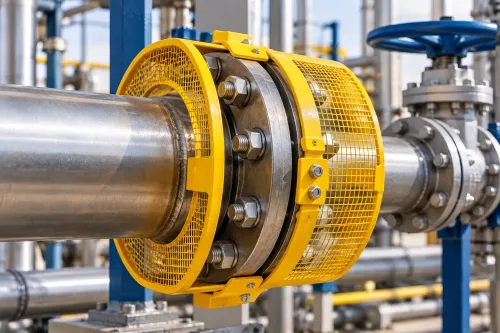
- Fit a guard over the belt, pulley spokes, exposed shafting, and nip points. OSHA 29 CFR 1910.219 names belt and pulley guarding requirements; Indian site rules may add obligations.
Store a flat transmission belt clean, dry, uncreased, and away from sunlight, ozone, solvents, and sharp bends. A crease can later appear as tracking instability or splice failure.
Which belt construction and supplier documents fit Mumbai conditions?
Monsoon humidity, washdown, roof leakage, oil mist, chemicals, abrasive dust, heat, and outdoor exposure must drive the specification. A wet or oily belt can lose friction and slip; chemical resistance does not rescue a weak splice. Select the cover and construction for the actual flat belt applications.
| Construction | Strengths | Check before selection |
|---|---|---|
| Rubber or fabric-reinforced | Friction, flexibility, impact tolerance, and varied temperature performance | Cover compound, oil and chemical compatibility, heat limit |
| Leather | Suits established drives with proven pulley geometry and dry service | Humidity, water, oil, outdoor exposure, and existing-drive suitability |
| Nylon | Useful when the specified duty requires its tensile or impact properties | Manufacturer’s temperature, pulley-diameter, and joining limits |
| Polyurethane | Clean operation, weldable endless joining, and resistance to many oils | Hydrolysis, abrasive dust, friction when contaminated, and splice strength |
A welded endless joint avoids a fastener crossing the pulley, but welding needs clean preparation, the specified temperature and pressure, accurate alignment, and controlled cooling. Mechanical fasteners simplify field installation; excessive fastener thickness creates noise, pulley wear, tracking trouble, or guard-clearance problems.
Ask an industrial flat belt supplier in Mumbai for:
- Construction, width and thickness tolerances
- Minimum pulley diameter and permissible speed
- Power rating or power-per-width data
- Temperature range and chemical-resistance data
- Splice preparation and joining instructions
- Traceable material or batch identification
Give M/S Gautam Bearing & Tools the measured dimensions, joint type, failure pattern, and exposure conditions rather than an old nominal length alone.
Related product
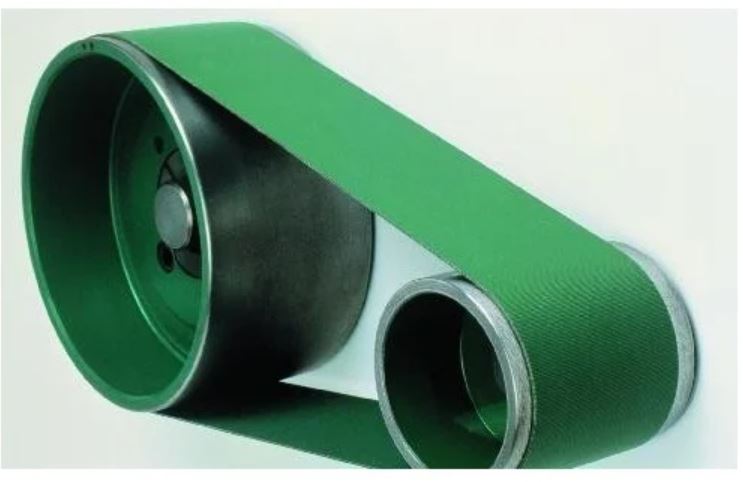 | Belts & Industrial Transmission Products Flat Belts are versatile power transmission belts designed to transfer motion and power between pulleys efficiently. View product → |
Frequently asked questions
Which Mumbai pump and compressor machines use flat belts?
Legacy line-shaft pumps, open-drive centrifugal pumps, reciprocating compressors with flywheels, blowers, fans, conveyors, textile machinery, and older machine tools use flat belts. New centrifugal pumps more often use direct couplings or V-belts.
How do you identify and measure an existing flat-belt drive?
Record the belt width, thickness, inside or outside length, pulley diameters, shaft spacing, shaft speeds, belt direction, and joint type. Photograph pulley crowns, guides, tensioners, and any markings before removal.
How do you calculate flat-belt speed and starting duty?
Calculate belt speed as π × pulley diameter × pulley RPM, using consistent units. Compare transmitted power, driven-machine torque, acceleration time, shock loading, and start-stop frequency with the belt supplier's rating.
How do alignment, tension, and pulley condition prevent flat-belt slip?
Align shafts and pulley faces, set tension to the belt maker's specified range, and inspect for worn crowns, burrs, oil, water, and contamination. Excess tension damages bearings without fixing a damaged pulley.
Which flat-belt construction and supplier documents suit Mumbai conditions?
Compare leather, rubber, polyurethane, and fabric-reinforced constructions against humidity, oil, temperature, washdown, load, and joint requirements. Request the belt datasheet, splice instructions, dimensions, power-rating basis, storage limits, and material information.
Keywords