A request for “one circlip” or “one sealing washer” is not specific enough to produce a reliable fit. By checking the installation location, groove or sealing-face dimensions, material, standard, and service conditions, you can place an order that matches the machine instead of correcting a costly mismatch after delivery.
Key takeaways
- Match external circlips to DIN 471 and internal circlips to DIN 472.
- Measure shaft, bore, groove diameter, groove width, and ring thickness before ordering.
- Select bonded washers by seal compound, mating-face material, pressure, and temperature.
- Record dimensions, material, finish, quantity, and inspection points on your purchase request.
Specify the Circlip by Installation Location and Groove Dimensions
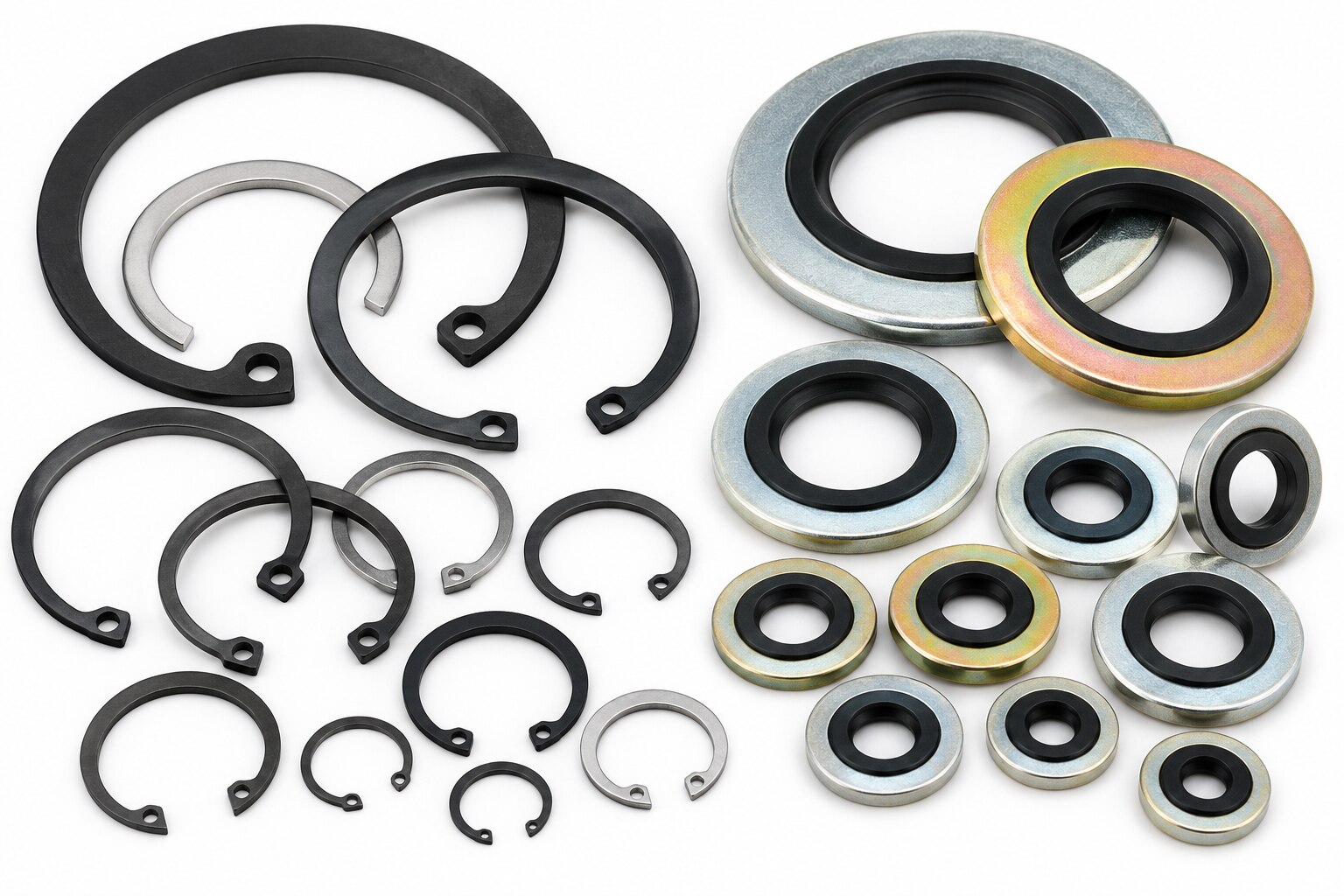
Start with the installation location: an external circlip fits around a shaft, while an internal circlip fits inside a bore. External shaft rings normally follow DIN 471; internal bore rings normally follow DIN 472. Their lug positions, ring profiles, groove diameters, and installation dimensions differ, so one cannot replace the other.
| Type | Nominal reference | Groove location | Confirm before ordering |
|---|---|---|---|
| External, DIN 471 | Shaft diameter | Machined in the shaft | Groove diameter, width, ring thickness, shoulder load |
| Internal, DIN 472 | Bore diameter | Machined in the housing | Groove diameter, width, ring thickness, shoulder load |
Give the nominal shaft diameter for an external ring or the nominal bore diameter for an internal ring. Then provide:
- Groove bottom diameter
- Groove width
- Ring thickness or section
- Axial load that the retaining shoulder must withstand
Do not identify the circlip by free diameter alone. Its advertised nominal size usually describes the shaft or bore it is designed to fit, not its relaxed measurement. State whether the groove is in a shaft or housing, and send a drawing or removed sample when measurements are uncertain.
This prevents ordering an internal ring for a shaft or selecting a section too thin for the load. A search for circlips near me or circlips and bonded washers Bibijan Street in Mumbai is useful only after these dimensions are confirmed.
Separate DIN Circlips from Snap Rings, Retaining Rings, and E-Clips
“Retaining ring” and “snap ring” are broad names for several spring-steel retaining systems. DIN 471 identifies an external circlip for a shaft, while DIN 472 identifies an internal circlip for a bore; each requires its own groove dimensions.
| Type | Standard or profile | Interchangeability |
|---|---|---|
| External circlip | DIN 471, full circumference on a shaft | Interchangeable only with the same DIN 471 size and groove specification |
| Internal circlip | DIN 472, seated inside a bore | Interchangeable only with the same DIN 472 size and groove specification |
| E-clip | Open-sided profile gripping a shaft | Not a replacement for a full-circumference DIN 471 ring |
| C-clip or spiral ring | Separate profile and installation method | Not interchangeable with DIN 471 or DIN 472 |
An E-clip uses a different groove arrangement, while C-clips, spiral retaining rings, and stamped retaining rings need their own groove geometry and fitting tools. Treat catalogue references as equivalent only after confirming the standard, nominal size, section, groove width, groove diameter, and load rating.
Measure these separately before ordering:
- Shaft diameter and shaft-groove bottom diameter
- Bore diameter and internal-ring groove diameter
- Groove width, shoulder height, and ring thickness
Measuring the shaft instead of its groove can select the wrong section; measuring the housing bore instead of the internal groove creates the same error. Use vernier calipers or a drawing, especially when searching “circlips near me” or contacting a circlip supplier in Mumbai. A visual match is not proof of adequate axial retention.
Compare Circlip Material, Finish, Installation, and Reuse Risk
After dimensions are confirmed, choose the material and finish for the environment, then fit the ring without overstressing it. Carbon spring steel suits many dry, indoor assemblies and commonly comes with zinc or phosphate protection.
Stainless steel suits humidity, washdown, salt, or chemical exposure when plated carbon steel would corrode, but it is not an automatic substitute.
| Material and finish | What it means | When it applies |
|---|---|---|
| Carbon spring steel, zinc finish | General spring strength with corrosion protection | Dry indoor machinery and ordinary service |
| Carbon spring steel, phosphate finish | Protective surface with a dark conversion coating | Dry service where the specified finish is acceptable |
| Stainless steel | Better corrosion resistance, with different strength and spring behaviour by grade | Washdown, humidity, salt, or chemical exposure after checking load, temperature, and compatibility |
Use circlip pliers sized for the lug holes. Expand an external ring only enough to pass over the shaft; compress an internal ring only enough to enter the bore.
Follow the drawing or supplier orientation for the lugs, seat the ring fully in its groove, and ask a circlip supplier in Mumbai to confirm the grade when temperature or chemicals matter.
- Remove burrs before installation.
- Inspect the groove for peening, cracks, and wear.
- Rotate or inspect the assembly for continuous seating, with no lifted section or distorted ear.
- Do not reuse a ring that has permanently opened, closed, twisted, or lost its spring shape; it can appear seated while providing inadequate axial retention.
Choose a Bonded Washer by Seal Compound and Mating Face
Order a bonded washer by its sealing duty, not by the bolt label alone. State the thread system—metric, BSP, or another standard—and nominal fastener size, then confirm the inside diameter, outside diameter, and metal washer thickness. A size mismatch can leave the seal unsupported or block the threaded hole.
| Option | Compound or product | Suitable service | Do not substitute for |
|---|---|---|---|
| NBR | Mineral oil and ordinary hydraulic fluid | Confirm the actual compound rating | Fuel, hot chemical, or all-fluid service |
| FKM | Higher temperature, fuel, or chemical exposure | Use only after compatibility confirmation | Automatically compatible with every solvent |
| EPDM | Hot water and glycol | Confirm temperature and fluid limits | Petroleum oils and many mineral-oil systems |
| Copper, aluminium, fibre, or plain metal washer | Different crush, packing, or load-distribution mechanisms | Select for the joint’s specified design | A bonded seal without checking the sealing method |
Give a bonded washer supplier in Mumbai these details:
- Elastomer designation, never just “rubber”
- Maximum working pressure and pressure-cycle duty
- Minimum and maximum service temperature
- Tightening-torque limit from the fastener, thread, lubrication, sealing face, and joint design—not nominal bolt size alone
A bonded washer seals beneath a bolt head, plug, or flange. It does not replace a plain washer where load distribution is required, and it cannot seal a scratched, misaligned, excessively rough, or damaged face. Replace it after removal in critical hydraulic joints, especially after heat, pressure cycling, or chemical exposure.
Ask for these specifications when comparing industrial sealing washers in Mumbai.
Make a Local Purchase Request That Can Be Checked at Delivery
A written schedule makes a local purchase checkable: proximity cannot confirm that a ring fits your groove or that a seal suits your fluid.
For circlips and bonded washers near Bibijan Street in Mumbai, send the supplier:
- Circlip: external shaft or internal bore type; DIN 471 or DIN 472 where applicable; nominal shaft or bore size; groove diameter, width and shoulder height; ring thickness; material; finish; quantity; drawing or removed sample.
- Bonded washer: metric, BSP or other thread standard; inside and outside diameters; metal thickness; elastomer; fluid; pressure; temperature; quantity.
M/S Gautam Bearing & Tools can use these details to confirm actual stock instead of treating “circlips near me” or “sealing washers” as a specification. A circlip supplier in Mumbai may stock common carbon-steel sizes but source stainless, heavy-section or unusual bore sizes to order.
| Product | Check against request | Reject if |
|---|---|---|
| External circlip | DIN 471, shaft size, groove and section | Cracked, burred, distorted lugs, wrong finish or altered free shape |
| Internal circlip | DIN 472, bore size, groove and section | Wrong type, damaged ears or incomplete free shape |
| Bonded washer | Thread, diameters, metal and elastomer | Off-centre bore, cuts, voids, poor bonding, corrosion or wrong combination |
A bonded washer supplier in Mumbai may classify several products as industrial sealing washers in Mumbai; verify that you received a bonded seal, not a copper crush, fibre or plain metal washer. Keep the package label and batch information with the maintenance record.
Frequently asked questions
How do I specify the correct circlip?
State whether it fits around a shaft or inside a bore, then provide the shaft or bore diameter, groove diameter, groove width, ring thickness, and installation clearance. External shaft rings normally follow DIN 471; internal bore rings normally follow DIN 472.
What is the difference between a DIN circlip, snap ring, retaining ring, and E-clip?
A DIN circlip is identified by a standard ring profile and installation dimensions. Snap ring and retaining ring are broader terms that include several ring designs, while an E-clip has an open E-shaped profile that fits into a shaft groove from the side.
Can I reuse a circlip after removal?
Treat a removed circlip as replaceable unless the manufacturer explicitly permits reuse. Discard it if the ring is permanently opened, twisted, scratched, corroded, or no longer seats fully in the groove.
How do I choose a bonded washer?
Match the washer’s inner diameter and outer diameter to the fastener and mating face. Select the sealing compound, such as nitrile rubber or fluorocarbon rubber, for the fluid and temperature, and confirm the washer suits the bolt head, plug, flange, or machined face.
What should I include in a local purchase request?
List the part type, standard, nominal size, exact groove or mating-face dimensions, material, surface finish, seal compound, quantity, application fluid, temperature, pressure, and required inspection documents. Check these details against the delivery label and parts before acceptance.
Keywords