Choosing a clamp by pipe name alone can leave you with a loose support, a crushed hose, galvanic corrosion, or a fitting that cannot handle vibration. By the end, you will be able to identify the clamp type, measure the pipe correctly, specify the mounting and environmental requirements, and ask a Mumbai supplier for information that proves the part suits your installation.
Key takeaways
- Measure the pipe’s outside diameter before selecting a clamp.
- Specify fluid, temperature, exposure, and mounting surface.
- Use pipe supports for restraint—not as pressure-boundary repairs.
- Include size, material, quantity, and application in your enquiry.
What a PVC or aluminum pipe clamp actually does
A PVC pipe clamp is a support, guide, restraint, or spacing component—not a pressure-boundary fitting. It holds or guides pipe against a wall, machine frame, panel, or support rail. It is not a solvent-cement joint, threaded fitting, flange, union, or pressure-repair clamp.
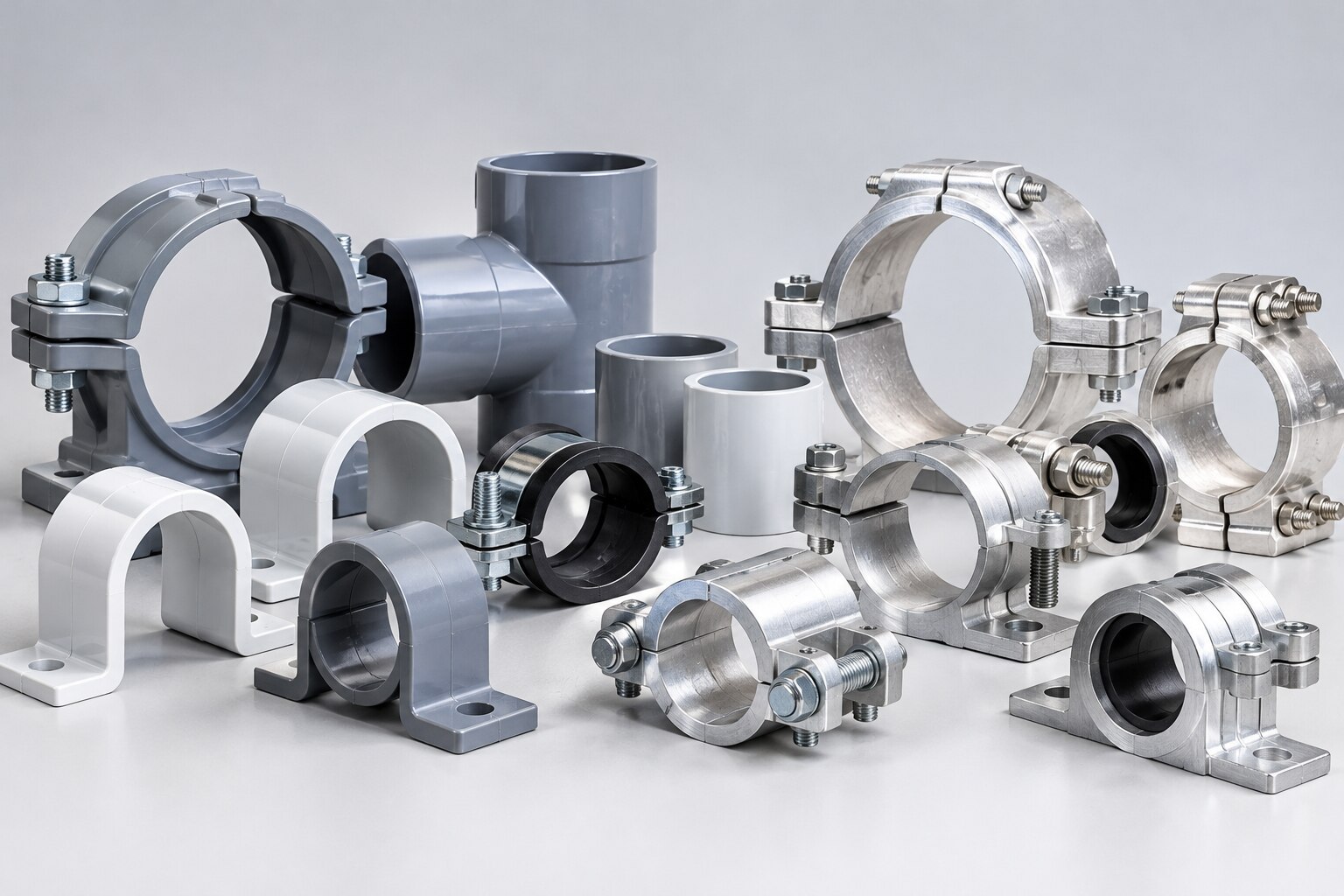
An aluminum clamp supplies a rigid metal body for securing pipe or tube, but it may need a separate elastomer insert.
| Design | What it does | Typical use |
|---|---|---|
| Standard pipe clamp | Holds a pipe at a fixed point | Wall, frame, or panel support |
| Cushioned clamp | Adds an elastomer liner against vibration and abrasion | Tubes, hoses, painted or sensitive surfaces |
| Two-bolt clamp | Tightens two halves around the pipe | Firmer restraint and heavier mounting |
| Saddle clamp | Supports a pipe from below or provides a shaped seat | Horizontal runs and larger pipe |
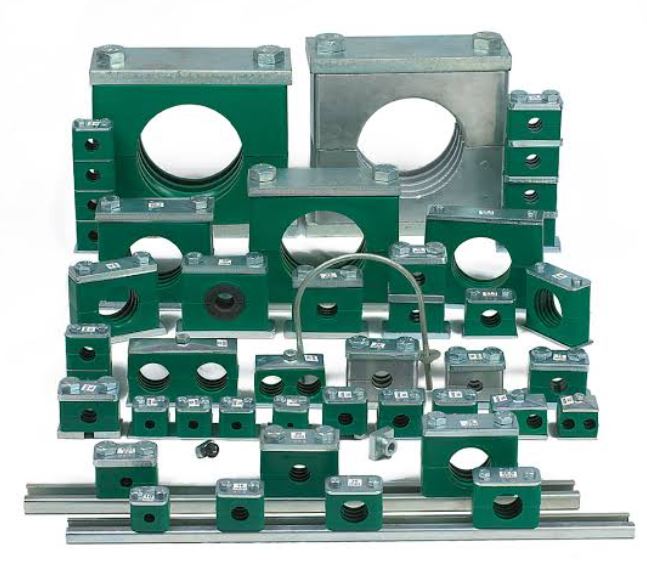
| Heavy-duty hydraulic clamp | Restrains tube movement with matched halves and an insert | Hydraulic, pneumatic, and high-pressure lines |
Do not confuse a complete clamp with a PVC cushioning insert, pipe saddle, mounting block, branch saddle, or pipe clip. A branch saddle creates a connection; a leak-repair clamp seals a damaged pressure line.
Searching for pvc clamp pipe fitting in Mumbai can return all of these non-interchangeable products, so state whether you need pipe support, a branch connection, leak repair, or vibration restraint.
A leaking pressurized PVC line needs a repair system rated for its pipe, fluid, pressure, and temperature. An ordinary support clamp will not stop the leak.
How to measure the pipe and specify the clamp size
Measure the actual outside diameter at the clamp location; a label such as “25 mm” or “1 inch” does not guarantee the clamp will fit. A loose clamp permits vibration, while an undersized one crushes hose or deforms pipe.
1. Use calipers on the finished outside surface. Measure over the hose cover, insulation, paint, or protective sleeve when that layer remains inside the clamp. Record the measured OD in millimetres.
2. Identify the construction: metric PVC, NPS/IPS PVC, CPVC, hose, or pneumatic tubing. Similar nominal sizes can have different outside diameters, so do not specify only nominal bore, thread size, or the pipe label.
3. State the required manufacturer’s OD range, clamp series, and metric or inch sizing. Include the mounting-hole diameter, bolt size, and whether the quotation covers one complete clamp or a matched upper-and-lower pair.
4. Describe the fit: it must hold the pipe without crushing flexible hose, restricting thermal movement, or permitting excessive vibration. Specify the insert material, bore, edge profile, and tightening method.
5. Send the pipe OD, material, quantity, mounting surface, and duty to a pvc pipe clamp supplier in Mumbai. Ask for a dimensional drawing before ordering; this prevents a visually similar saddle, clip, or repair clamp from being supplied instead of a compatible support.
Match clamp construction to fluid, temperature, and exposure
Water, compressed air, hydraulic oil, fuel, and chemical service need different clamp materials and inserts. PVC components suit light-duty support and cushioning, but PVC-U and CPVC have different temperature capabilities; pressure derating and allowable service limits belong to the complete pipe-and-fitting system, not the clamp alone.
Broad contact, non-cutting edges, correct bore, controlled tightening, and a specified compliant liner prevent indentation, ovalisation, and stress cracking.
| Option | Suitable direction | Check before selection |
|---|---|---|
| PVC | Light-duty water or air support, cushioning | UV exposure, temperature, bore, and pressure derating |
| CPVC | Higher-temperature support than PVC-U | Complete system rating at operating temperature |
| Aluminum body | Rigid support for pipe or tube | Whether it includes an insert, coating, isolation, and drainage |
| NBR, EPDM, FKM, thermoplastic insert | Fluid-contact and vibration cushioning duties | Compatibility with oil, fuel, water, chemicals, and temperature |
For an aluminum pipe clamp supplier, specify these conditions:
- Match NBR, EPDM, FKM, or thermoplastic inserts to the actual fluid; a water-compatible insert may fail in petroleum hydraulic oil, while an oil-compatible insert may fail in hot water or chemical cleaning.
- Treat aluminum as vulnerable in Mumbai’s wet, coastal, chloride-bearing exposure. Isolate it from stainless steel, carbon steel, copper, and brass with suitable washers, fasteners, coating or anodizing, and drainage.
- State UV exposure, cleaning chemicals, vibration, heat, and electrical isolation requirements. Use nonconductive liners or isolation hardware where stray current or electrical sensitivity matters.
Choose the right design for rigid pipe, hose, and hydraulic lines
A rigid pipe support cannot substitute for a hydraulic or pneumatic tube restraint. Rigid pipe runs need anchors separated from guides or sliding supports, allowing thermal expansion without loading solvent-cement joints, valves, or equipment nozzles.
| Design choice | What it must control | What goes wrong with the wrong clamp |
|---|---|---|
| Rigid pipe support | Pipe weight, alignment, and controlled movement | Rigidly clamping every point transfers thermal loads into joints and equipment |
| Hydraulic hose restraint | Pressure-induced movement, pulsation, vibration, and shock | A hard edge can cut the cover or flatten the hose |
| Pneumatic tube clamp | Tube retention without crushing or restricting the bore | Excessive tightening can reduce flow or cause cracking |
| High-pressure tube clamp | Matched halves, an elastomer insert, and defined load transfer | A generic PVC clip provides no dependable restraint basis |
Do not accept one support-spacing figure for every installation. Diameter, wall class, fluid temperature, mounting orientation, and allowable deflection determine the span.
For high-pressure tube work, ask whether the design follows a DIN 3015-style arrangement with matched upper and lower halves, an elastomer insert, support rail, stated bolt arrangement, and installation torque. Request these details before comparing industrial pipe clamps in Mumbai:
- Pressure rating, allowable load, support spacing, and safety factor
- Vibration or shock basis, fastener grade, bolt torque, and anchor assumptions
- Tube outside diameter, insert material, mounting orientation, and rail arrangement
A catalogue photograph or body material alone cannot establish suitability.
Build a purchase enquiry for Mumbai suppliers
Send Mumbai suppliers a specification, not just “PVC clamp” or “aluminum clamp.” Use this numbered enquiry:
1. Please quote a pipe clamp for an outside diameter of [_ mm], pipe material [PVC-U, CPVC, hose, tube], schedule or pressure class [_], fluid [_], normal temperature [_ °C], and maximum temperature [___ °C].
State whether it is for indoor or outdoor use, pipe support or restraint, expected vibration, fastener material, liner requirement, corrosion environment, mounting surface, quantity, and delivery location.
2. Include the dimensional drawing, clamp series, OD range, metric or inch sizing, mounting-hole diameter, bolt size, body material, insert material, and any applicable dimensional standard. Provide the pressure or load basis, test condition, safety factor, anchor assumptions, installation torque, and support-spacing guidance.
3. Identify exactly what you are quoting: a single clamp, matched pair, saddle, clip, mounting block, repair clamp, or branch saddle. Confirm whether the assembly suits a rigid pipe, hose, or hydraulic tube; a generic support clamp is not a pressure-repair system.
For the search phrase pipe camp supplier near masjid bunder, write pipe clamp in the enquiry. The spelling “camp” can miss relevant listings. M/S Gautam Bearing & Tools near Bibijan Street in Masjid Bunder can be one local contact for checking availability, but verify dimensions, stock, documents, and service suitability.
Proximity does not prove fit or pressure capability.
Related product
 | Hydraulic, Pnuematic Fittings & Automation Valves, Pumps, Tubes PVC Clamp/pipe Camp /Aluminum Clamp PVC Clamp/pipe Camp /Aluminum Clamp. View product → |
Frequently asked questions
What does a PVC or aluminum pipe clamp do?
It supports, guides, restrains, or spaces a pipe against a wall, frame, panel, or support rail. It is not a solvent-cement joint, threaded fitting, flange, union, or pressure-repair clamp.
How do you specify the correct pipe clamp size?
Measure the pipe’s outside diameter at the clamping point, then state the diameter in millimetres. Also identify whether the clamp must grip rigid pipe, hose, or a hydraulic line.
How should clamp material match the application?
Check the conveyed fluid, operating temperature, sunlight, moisture, chemicals, vibration, and mounting environment before choosing PVC, aluminum, or another clamp construction.
What should you include in an enquiry to a Mumbai pipe clamp supplier?
State the pipe outside diameter, clamp material, pipe or hose type, service fluid, temperature range, mounting method, quantity, delivery location, and any required fasteners.
Keywords