A shaft can run hot, vibrate, damage seals, or fail early when angular misalignment and thermal growth force a conventional bearing to carry loads it was not designed to handle. You will learn how the toroidal roller profile responds to these movements, how to arrange the locating and floating bearings, and how to select and install the correct bearing for an industrial machine.
Key takeaways
- Use a locating bearing with the CARB bearing to control axial shaft position.
- Calculate thermal expansion before deciding which bearing locates the shaft.
- Leave the CARB bearing free to move axially inside its housing.
- Check symptoms such as overheating, noise, and roller damage for arrangement errors.
How the toroidal roller geometry manages shaft movement
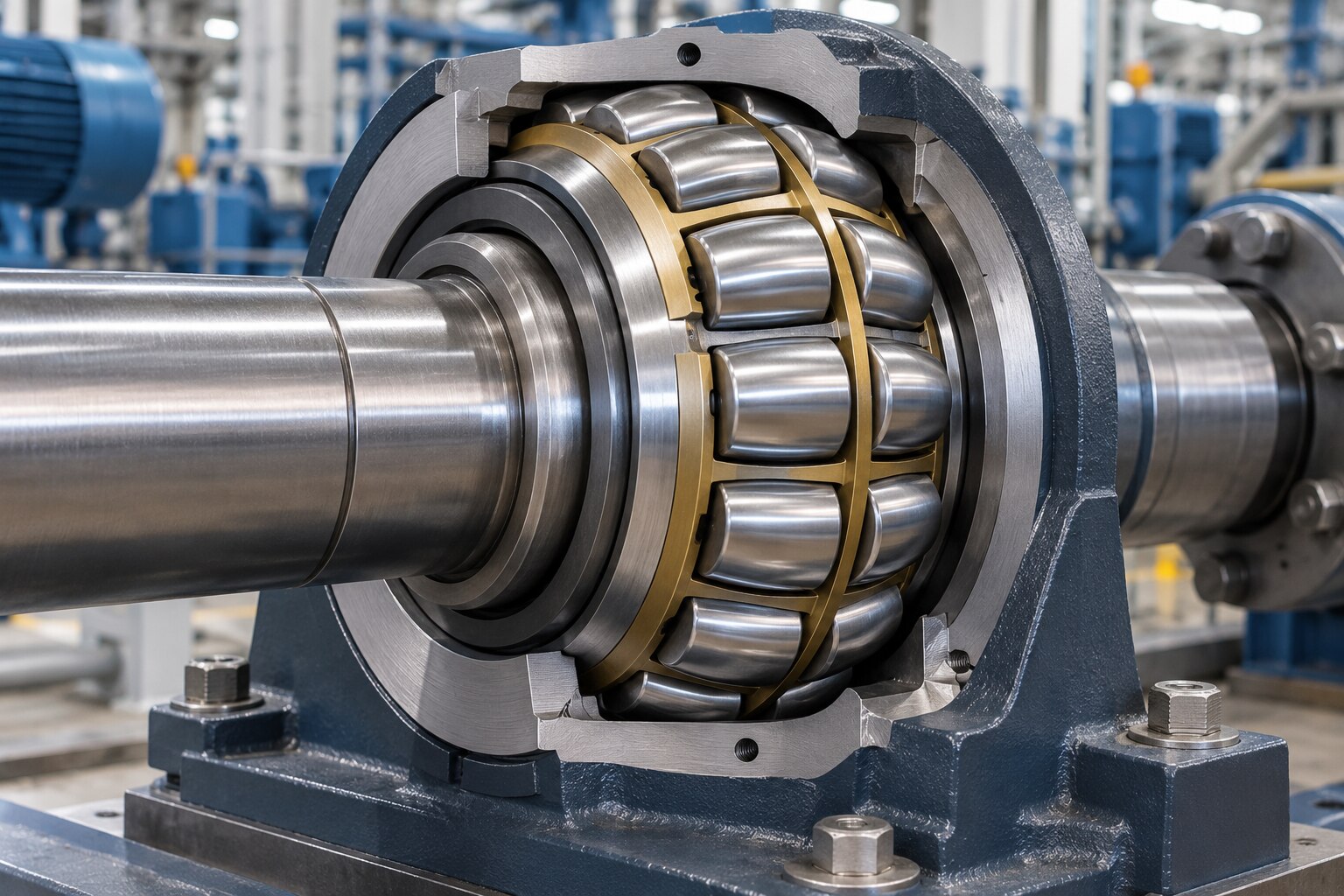
A CARB bearing accommodates shaft-to-housing angular misalignment of approximately 0.5° under normal operating conditions without concentrating load at a roller edge. Its toroidal rollers have a curved profile, while the inner and outer raceways guide that curve, keeping the roller contact aligned as the shaft tilts relative to the housing.
The same geometry permits axial movement inside the bearing. As the shaft grows from heat, the rollers shift axially along the raceways instead of forcing the housing or the locating bearing to move. That internal movement prevents axial preload, roller skew, rising temperature, and premature fatigue.
This is different from correcting a bent or deflected shaft. The CARB bearing follows angular alignment between shaft and housing; it does not straighten the shaft or absorb substantial external thrust. Treat it primarily as a radial-load, non-locating bearing. A separate locating bearing must control the shaft’s axial position.
CARB bearing applications include machines where thermal growth or housing deflection is difficult to eliminate:
- Conveyor drums and long conveyor shafts
- Gearboxes and industrial fans
- Pumps with heat-producing or continuously running drives
- Textile machinery with long shafts
- Steel-processing equipment exposed to high operating temperatures
If installation leaves both bearings axially fixed, the CARB bearing cannot float. The resulting trapped expansion can produce hot running and damaging contact loads even when the bearing size and radial capacity are correct.
Which machine symptoms point to the wrong bearing arrangement
A bearing that runs hot, vibrates, or fails soon after installation is signalling a geometry or arrangement problem, not automatically a bad bearing. Compare the symptom with the machine condition before changing lubricant or increasing clearance.
| Symptom | Likely cause | What to inspect |
|---|---|---|
| Hot running after startup | Both bearings axially locating the shaft, or expansion blocked | Check whether the CARB bearing can float and whether shoulders, seals, spacers, or retaining rings obstruct movement |
| Vibration with polished roller edges | Housing-bore misalignment, shaft bending, or excessive runout | Measure shaft runout and check housing alignment under operating load |
| Repeated seal damage | Bearing displacement, shaft misalignment, abrasive dust, or water ingress | Inspect seal material, shaft finish, contamination, and exact bearing designation |
| Short life after thermal cycling | Floating movement is insufficient or the locating bearing is overloaded | Compare measured shaft growth with the available internal displacement |
| Early edge loading or uneven raceway marks | Distorted housing, soft support, or a mounting shoulder that is not square | Blue-check contact surfaces and verify shoulder squareness |
A CARB bearing handles angular misalignment and axial displacement, but it does not straighten a bent shaft or correct a distorted housing. In conveyors, fans, pumps, textile equipment, gearboxes, and steel machinery, Mumbai dust, humidity, and heat make these faults easier to expose.
Stop the machine if temperature rises sharply, vibration changes with load, or grease contains metal. Before ordering, record radial load, speed, fits, temperature, contamination, sealing, misalignment, expansion, and which bearing locates the shaft. Those details separate suitable CARB bearing applications from an arrangement that will fail again.
How to calculate thermal expansion and arrange the locating bearing
Calculate the relative growth between the locating bearing and the CARB bearing at operating temperature. Use Δx ≈ αsLsΔTs − αhLhΔTh; for steel, α is about 12 × 10⁻⁶/K. A 2 m shaft rising 80°C expands approximately 1.92 mm if the housing remains at its reference temperature.
Use the bearing-span length actually free to grow, not the shaft’s total length. Add measured assembly movement and the manufacturer’s required operating margin, then compare the result with the CARB bearing’s permitted axial displacement. A shoulder, seal, spacer, retaining ring, or tight housing fit that blocks this travel turns thermal growth into axial preload.
| Bearing arrangement | Axial-position function | What happens during shaft growth |
|---|---|---|
| Locating bearing | Fixes the shaft’s axial reference | Takes thrust and prevents uncontrolled shaft migration |
| CARB non-locating bearing | Floats axially while carrying radial load | Allows expansion inside the bearing |
| Both bearings located | Incorrect arrangement | Creates preload, heat, roller skew, and early failure |
Place one bearing as the locating bearing and allow the CARB bearing to float in its housing or on its shaft, according to the design. Do not use the CARB bearing to control shaft position unless the complete arrangement specifically permits it.
Before assembly, verify the calculated movement against the supplier’s catalog displacement limit. Check that seals, shoulders, locknuts, and housing covers do not contact the floating ring at either thermal extreme. Measure shaft and housing temperatures separately when the machine has a large temperature gradient.
How to select and mount a CARB bearing without blocking its movement
A sound carb bearing selection starts with the duty, not the bore diameter. Confirm radial load, equivalent dynamic load, static safety, speed, expected angular misalignment, thermal displacement and any external thrust. CARB bearings are primarily radial bearings; let the locating bearing carry and control shaft thrust.
| Check | Select or verify | Failure if wrong |
|---|---|---|
| Speed and load | Dynamic and static ratings, cage type, limiting speed | Heat, skidding or early fatigue |
| Clearance and fit | Internal clearance for temperature and interference fits; shaft and housing tolerances | Preload, looseness or blocked float |
| Lubrication | Grease or oil viscosity, fill quantity and relubrication interval | High temperature and lubricant starvation |
| Sealing | Seal material, speed, temperature and dust or water exposure | Abrasive contamination or grease loss |
Internal clearance is not a universal C3 choice. Calculate the reduction caused by the shaft and housing fits, then match the remaining operating clearance to temperature and speed. Ask for the exact designation rather than substituting a bearing with the same bore.
Mount the rings squarely on clean, undamaged seats. Use a calibrated induction heater or mounting tool that applies force only to the ring being fitted; driving through the rollers brinells the raceways. Do not force the CARB bearing against skewed shoulders, distorted housings or excessive shaft runout.
The bearing must accommodate axial movement internally, while the locating bearing remains correctly fitted and capable of carrying the machine’s axial load. Sealed versions simplify contamination control, but they still require the specified grease, speed and temperature limits.
What to request from a CARB bearing supplier in Mumbai
Compare the complete bearing designation and supporting documents, not the bore diameter or a photograph. A carb bearing supplier in mumbai should receive your machine data before quoting, then return a bearing that matches the complete operating arrangement.
- Radial load, speed, duty cycle, and any external thrust
- Shaft and housing diameters, fits, and available shoulder dimensions
- Operating temperature, expected shaft growth, and angular misalignment
- Lubricant type and delivery method, contamination level, and sealing requirement
- Locating-bearing position and the axial travel the CARB bearing must permit
| Item to request | Acceptable quotation | Warning sign |
|---|---|---|
| Complete designation | Bore, dimensional series, internal clearance, cage or variant, and open or sealed configuration | “CARB bearing” with no suffixes |
| Traceability | Manufacturer, country of origin, batch or lot number, and matching packaging marks | Loose bearing or relabelled packaging |
| Fit and movement check | Shaft and housing fits, permitted displacement, and installation limits stated against your dimensions | Only a nominal bore and outside diameter |
| Operating suitability | Load, speed, temperature, lubricant, and misalignment checked against the selected designation | Generic load or speed figures with no assumptions |
Ask a toroidal roller bearing supplier in mumbai to identify any difference between the quoted CARB bearing and your specified variant; a spherical or cylindrical roller substitute changes axial-location behaviour and fits.
M/S Gautam Bearing & Tools can be included in the comparison by requesting the same designation, traceability documents, and application review from every shortlisted source.
Related product
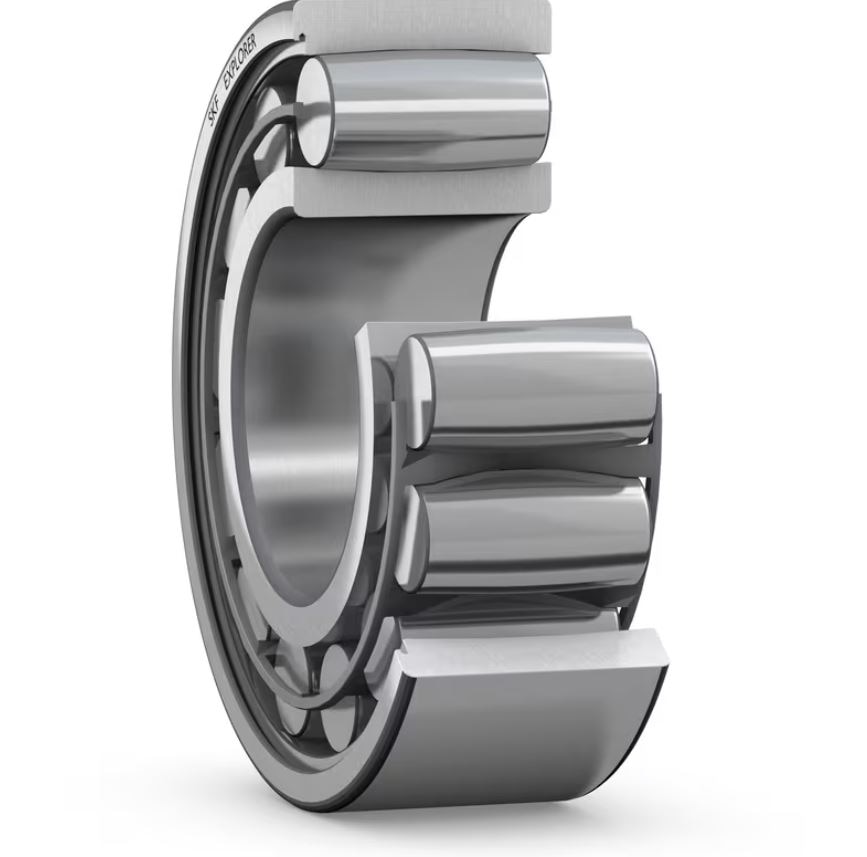 | Bearings CARB Toroidal Roller Bearings are advanced self-aligning bearings designed to accommodate both misalignment and axial displacement without generating... View product → |
Frequently asked questions
How does a CARB toroidal roller bearing handle shaft misalignment?
Its curved toroidal rollers and matching raceways maintain aligned contact when the shaft tilts relative to the housing, reducing edge loading.
Which symptoms suggest the bearing arrangement is wrong?
Overheating, abnormal noise, vibration, premature roller or raceway damage, and axial forces in a non-locating bearing indicate an arrangement problem.
How do you calculate shaft thermal expansion for a CARB bearing arrangement?
Calculate expansion with ΔL = α × L × ΔT, then use the result to position the locating bearing and provide axial movement at the CARB bearing.
How should you mount a CARB bearing without blocking axial movement?
Seat the bearing correctly, align the housing and shaft, apply the specified fit and clearance, and prevent seals, shoulders, or clamping parts from restricting axial displacement.
What should you request from a CARB bearing supplier in Mumbai?
Request the bearing designation, load and speed ratings, internal clearance, material and seal details, dimensional drawing, installation guidance, and traceability documents.
Keywords