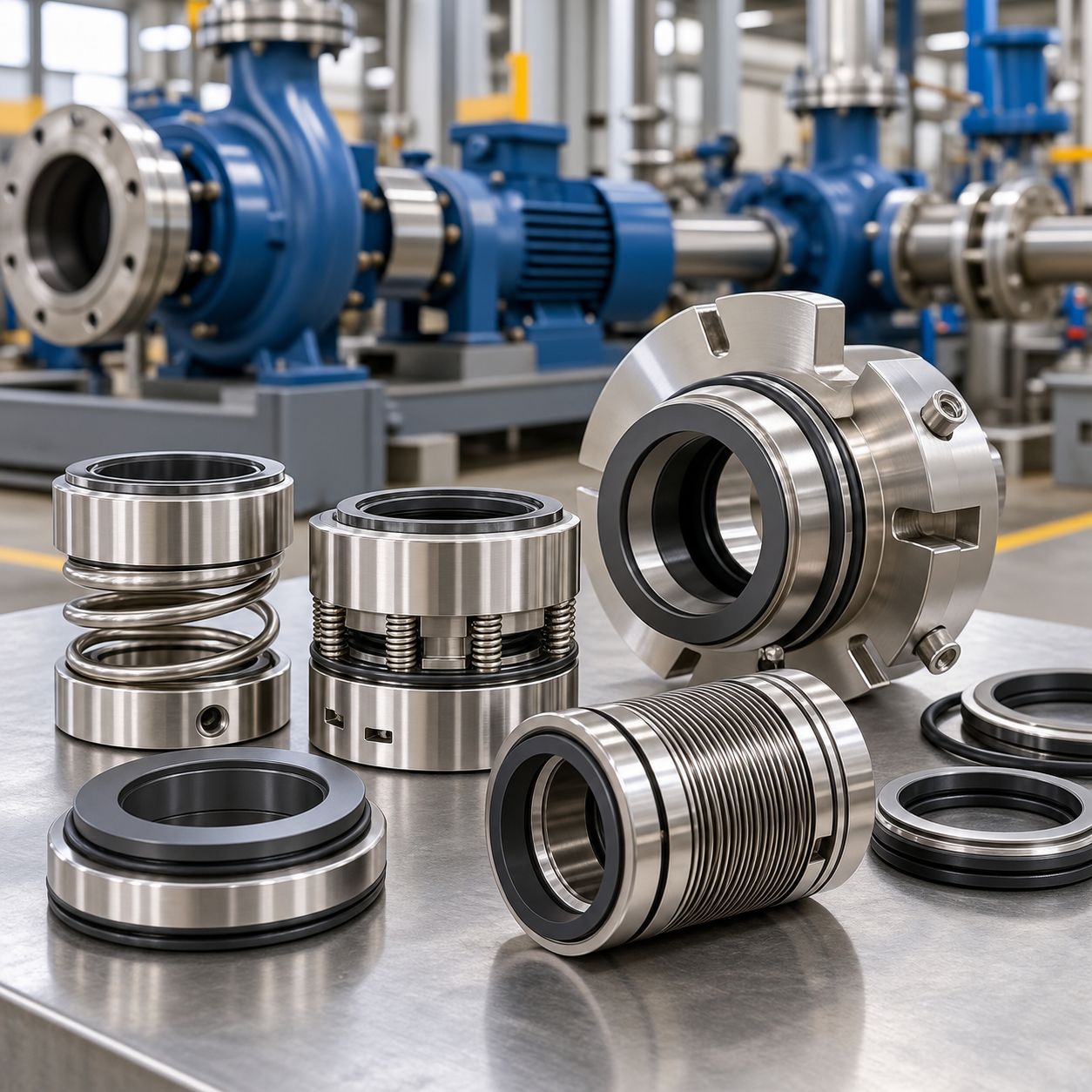
Mechanical seals are critical components in many rotating equipment applications, particularly where fluid must be contained around a rotating shaft. Pumps and process equipment can depend on the seal arrangement to control leakage while operating under combinations of pressure, temperature, speed, and chemical exposure.
For this reason, selecting an Industrial Mechanical Seals Supplier should involve technical verification before a purchase order is finalised.
Understand the Application First
Mechanical seals are not selected by shaft diameter alone.
Procurement and maintenance teams should gather information about:
- Equipment type
- Shaft diameter
- Fluid being handled
- Operating pressure
- Temperature
- Shaft speed
- Seal chamber conditions
- Existing seal arrangement
- Materials of construction
The properties of the process fluid are particularly important because seal faces and elastomers must be compatible with the medium.
Verify Seal Face Materials
Mechanical seal faces operate against each other with a very small interface between rotating and stationary components.
Different face-material combinations are used depending on operating conditions.
Material selection may need to consider lubrication characteristics of the fluid, temperature, abrasiveness, corrosion, and pressure.
A seal that works effectively in clean water service may not automatically be appropriate for chemical or abrasive process applications.
Check Elastomer Compatibility
O-rings and other secondary sealing elements can be affected by temperature and chemical exposure.
Incompatible elastomers may swell, harden, soften, crack, or lose sealing effectiveness.
Providing accurate fluid information is therefore essential when identifying replacement seals.
Investigate the Reason for Failure
A failed mechanical seal may be the result of another equipment condition.
Before replacement, check for issues such as:
- Dry running
- Excessive vibration
- Shaft runout
- Bearing wear
- Misalignment
- Incorrect installation
- Process temperature changes
- Pressure variation
- Contaminated fluid
- Inadequate flushing or cooling where required
Simply replacing the seal without correcting the underlying cause may lead to repeated leakage.
Assess Procurement Readiness
Before approaching a supplier, a maintenance team should ideally have:
- Existing seal model or reference
- Equipment make and model
- Shaft dimensions
- Process fluid details
- Pressure and temperature data
- Speed information
- Photographs or drawings where useful
- Previous failure observations
Having these details available reduces guesswork and improves communication between engineering and procurement teams.
Why Local Technical Supply Matters
Mumbai and Maharashtra have a broad base of process industries, manufacturing plants, engineering workshops, utilities, and OEM operations using pumps and rotating equipment.
When a critical seal fails, availability matters but supplying the wrong seal quickly does not solve the maintenance problem.
M/S Gautam Bearing & Tools supports industrial customers requiring mechanical seals, bearings, hydraulic and pneumatic components, hoses, fittings, gaskets, and lubrication products. A detailed requirement allows the provider to understand both the component and its intended operating environment.
The strongest purchasing decision is based on application compatibility rather than appearance or dimensions alone. By verifying fluid, pressure, temperature, speed, seal materials, equipment condition, and failure history, procurement managers can approach mechanical seal replacement as an engineering decision and improve the quality of maintenance planning.
Keywords