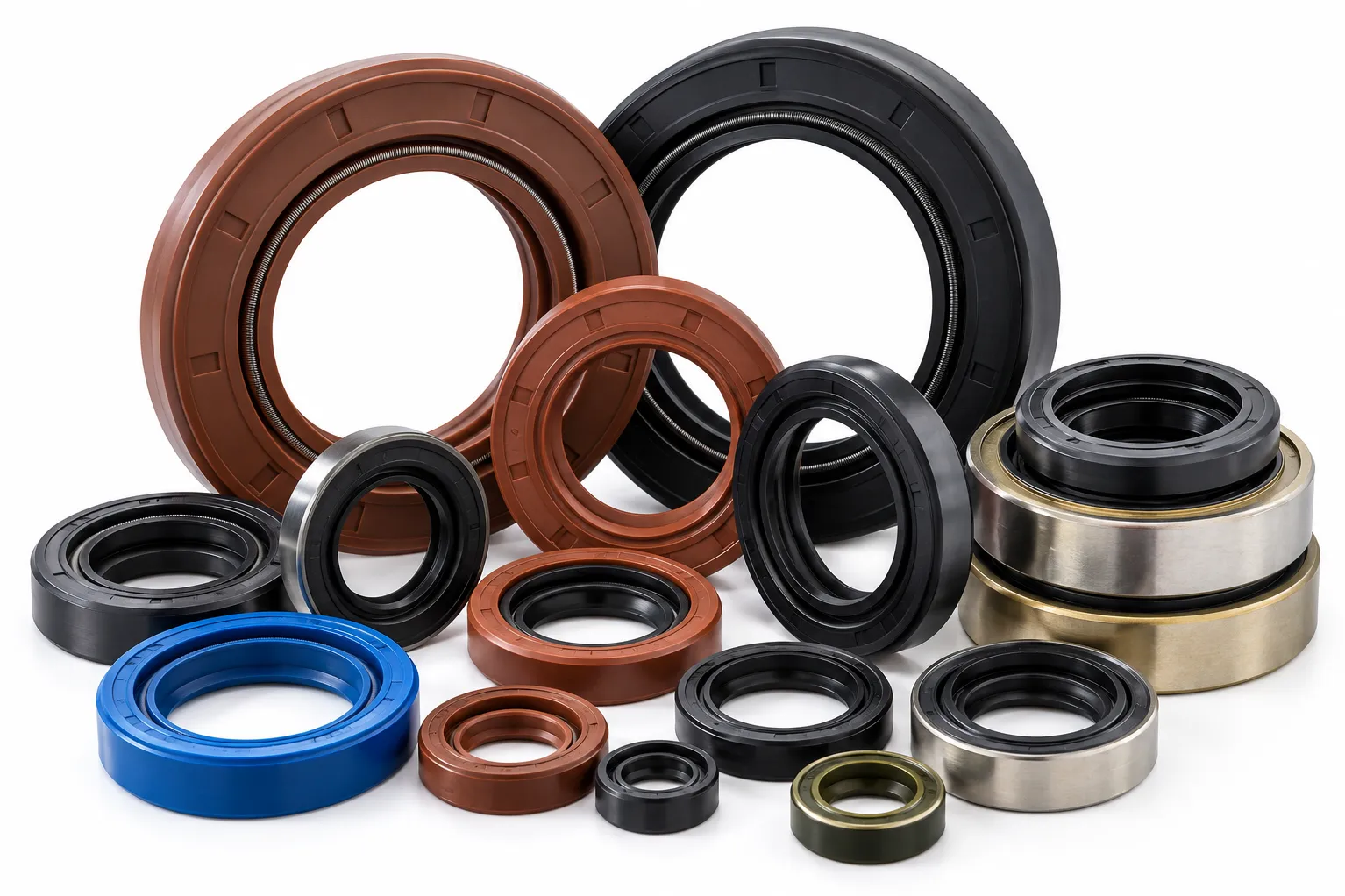
Oil seals appear simple, but their working environment is demanding. They operate at the interface between rotating and stationary components while helping retain lubricant and restrict contaminants. A small selection or installation error can lead to leakage, shaft wear, contamination, and repeated replacement.
Buyers evaluating an Industrial Oil Seal Manufacturer should understand the most common mistakes before specifying replacement seals.
Mistake 1: Selecting Only by Dimensions
Inside diameter, outside diameter, and width are essential, but they do not fully define an oil seal.
Buyers should also consider:
- Seal profile
- Lip design
- Material
- Shaft speed
- Temperature
- Lubricant
- Pressure conditions
- Rotation
- Environmental contamination
A dimensionally correct seal can still be unsuitable for the application.
Mistake 2: Ignoring Seal Material
Different elastomers have different resistance to temperature, oils, fuels, chemicals, and environmental exposure.
A material that performs adequately in a conventional gearbox may not be appropriate for elevated temperatures or aggressive media.
Always match material selection to actual operating conditions.
Mistake 3: Installing a New Seal on a Damaged Shaft
Over time, the sealing lip can create a wear track on the shaft. Corrosion, scratches, or poor surface finish can also affect sealing.
Installing a new seal over a damaged contact surface may produce leakage even when the seal itself is correct.
Inspect the shaft before replacement.
Mistake 4: Damaging the Lip During Installation
Sharp shaft edges, splines, threads, or inappropriate tools can cut the sealing lip.
Installation should be controlled so that the seal enters squarely and the lip is protected from sharp surfaces.
Hammering unevenly around the seal circumference can distort the component or damage the housing fit.
Mistake 5: Overlooking Lubrication
A sealing lip operating dry can generate excessive friction and heat.
Installation and initial operation should follow the seal manufacturer's lubrication recommendations.
Mistake 6: Treating Every Leak as Seal Failure
Oil appearing around a shaft does not automatically prove that the oil seal is defective.
Possible causes can include:
- Excessive internal pressure
- Blocked breathers
- Shaft runout
- Bearing wear
- Incorrect lubricant level
- Housing damage
- Improper installation
Diagnosing the system before replacement can prevent repeated failures.
Better Procurement for Industrial Applications
Mumbai's manufacturing, repair, marine-related, engineering, and processing sectors use oil seals across motors, pumps, gearboxes, industrial machinery, and power transmission assemblies.
M/S Gautam Bearing & Tools handles sealing and related industrial product requirements for customers in Mumbai, Maharashtra. For more accurate identification, buyers can provide the existing seal marking, complete dimensions, shaft application, temperature, speed, and lubricant information.
The cost of an oil seal may be modest compared with the machinery it protects. Selection should therefore focus on compatibility and operating conditions rather than treating the component as a generic consumable.
Correct dimensions, suitable material, good shaft condition, controlled installation, and proper system pressure all contribute to reliable sealing. Addressing these factors together is far more effective than repeatedly replacing a leaking seal without identifying the cause.
Keywords