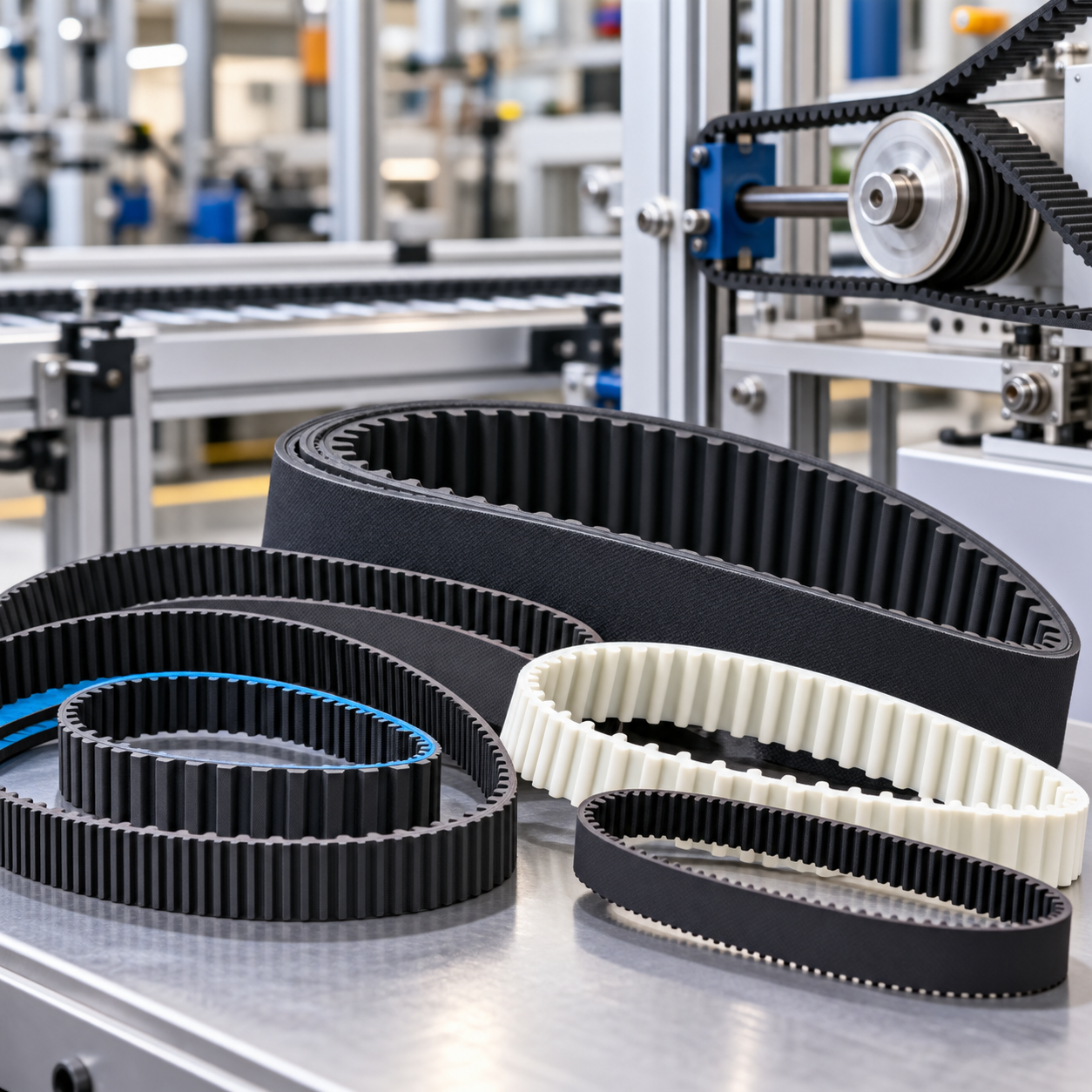
Timing belts are used where rotational motion needs to be transmitted while maintaining a defined relationship between driving and driven components. Their toothed construction provides positive engagement with matching pulleys, making them useful in machinery where synchronisation matters.
Selecting an Industrial Timing Belt Supplier becomes particularly important when maintenance teams need replacements for production equipment, automation systems, packaging machinery, or other power transmission applications.
Timing Belts Differ From Conventional V-Belts
A V-belt transmits power largely through friction between the belt and pulley surfaces.
A timing belt uses teeth that engage with corresponding pulley grooves. This helps maintain synchronised motion and prevents the type of slip associated with friction-drive arrangements under normal correctly specified operation.
That distinction makes timing belts valuable in applications requiring repeatable positioning or coordinated movement.
Identify the Belt Correctly
A timing belt should not be ordered simply by measuring its overall length.
Important specifications can include:
- Pitch
- Tooth profile
- Belt width
- Number of teeth
- Pitch length
- Material
- Reinforcement construction
- Matching pulley profile
Different tooth systems are not necessarily interchangeable.
The existing belt marking is often the most useful starting point for identification.
Why Timing Belts Fail Prematurely
Early failure may indicate a problem elsewhere in the drive.
Common causes include:
Incorrect tension: Excessive tension can increase bearing loads, while insufficient tension may affect engagement and drive performance.
Pulley misalignment: Misaligned pulleys can produce uneven wear and tracking problems.
Contamination: Oil, chemicals, debris, or other substances may affect belt materials depending on the design.
Worn pulleys: Replacing a belt while leaving severely worn pulleys in service can reduce the life of the new belt.
Incorrect installation: Forcing a belt over pulley flanges or using unsuitable tools can damage internal reinforcement.
Inspect the Complete Drive
When replacing a belt, maintenance teams should inspect:
- Driver pulley
- Driven pulley
- Tensioning arrangement
- Alignment
- Bearings
- Guards
- Contamination sources
- Belt tracking
This broader inspection can identify issues that would otherwise damage the replacement belt.
Plan Critical Spares
Manufacturing units often have specific timing belts that are not interchangeable with commonly available sizes.
For critical machines, procurement managers can maintain a record of belt specifications, machine locations, replacement frequency, and minimum stock levels.
This approach is particularly useful for factories in Mumbai and Maharashtra where production schedules can make unplanned downtime expensive.
M/S Gautam Bearing & Tools supplies industrial power transmission products alongside bearings and related maintenance components. Providing the complete belt designation and machine information helps make replacement identification more precise.
A timing belt should be treated as part of an integrated drive system. Correct tooth profile, pitch, width, tension, pulley condition, and alignment all influence performance. Buyers who evaluate the entire drive rather than simply replacing the worn belt can achieve more predictable maintenance outcomes.
Keywords